Executive summary
The minigame delivered on both of its objectives: distributing rewards and adding activity for existing players. In-game play time rose clearly for participants compared with a matched control group, with the largest gain among players of more than two years' tenure.
The two main limitations are reach, which is held back by the website running separately from the main game, and the fast drop-off of most social features after the opening days.
All traffic came from community channels. The minigame was promoted only in community groups, with no advertising and no entry point inside the game, so the 6.9% reach was achieved at no media cost.
Data cut-off. Website and in-game figures both cover the nine full days from 17 to 25 Nov. Every in-game comparison uses a control group matched by server, level band and spending tier.
01
Integration requirements
Compared against the integration flow already agreed for the Flappy Tay Du project: what is in place and what is still missing.
Current state
The minigame website runs independently from the main game. Players open it in a browser, create a separate account and type in their character details manually. This model was enough for a pilot, but it carries four limitations:
- Player identity is not synchronised between the website and the in-game account.
- Rewards cannot be delivered directly to the character.
- The full impact on play behaviour and revenue is hard to measure.
- Reach depends entirely on communication outside the game.
Status by item
| # | Item | Status | Notes |
|---|---|---|---|
| 1 | Player identity | Missing | Agreed with the SDK team: UID and RID will be passed through when the player opens the link from IAM. Planned for Q4 2026. Today players type in their own name and server, and only 31% do so |
| 2 | Game API integration SetCode rewards · item spend for extra plays · top-up log | Missing | Discussed with the API team. One engineer is needed to work through the integration, and this is the team's main concern. If that person is unavailable but the APIs and documentation are complete, the integration can still be done with AI assistance |
| 3 | In-game WebView | In place | Uses the IAM push-link system |
| 4 | GDS API for quests and activity checks | Missing | Not yet verified with GDS. Needed to grant plays based on in-game conditions |
| 5 | Data sharing with GPP | Missing | Metrics and the two-way data channel still need to be agreed |
| 6 | SetCode log reconciliation | In place | Can be traced through VNG logs |
| 7 | SRM security scan | In place | Birthday minigame has passed all security scan stages |
| 8 | Anti-cheat — layer 1 | In place | Server issues a seed per round, re-scores on the server with a score ceiling, and each round can be submitted only once |
| 9 | Anti-bot — layer 2 | In place | Checks play speed and how regular the input rhythm is. Abnormal rounds are rejected outright or queued for manual GM review |
| 10 | Review queue and account bans | In place | 834 rounds reviewed, 5 accounts banned. Banned accounts drop off the leaderboard and receive no codes |
| 11 | Server | In place | Runs on the Tay Du game GIO server — cost 1 million VND per month |
| 12 | Play session, time and result logging | In place | Running in production |
Proposed integration
- Priority 1 — Identity and rewards. Integrate the SDK to pass authenticated roleID, userID and serverID so accounts are synchronised. In parallel, implement the SetCode API to deliver rewards straight to the character instead of manual code entry.
- Priority 2 — Reach. Integrate WebView and the campaign system so players can open the minigame directly from the main game, removing the access and sign-up steps.
- Priority 3 — Gameplay depth. Add APIs for activity, quest and item checks to support mechanics such as granting plays, unlocking content or spending resources.
- Priority 4 — Tracking and reconciliation. Complete the reward log, top-up log and the data-sharing mechanism between web, game and GPP for accurate performance measurement.
Direction: use the Birthday pilot as the basis for turning the minigame into a reusable system for future events.
02
Objectives and headline results
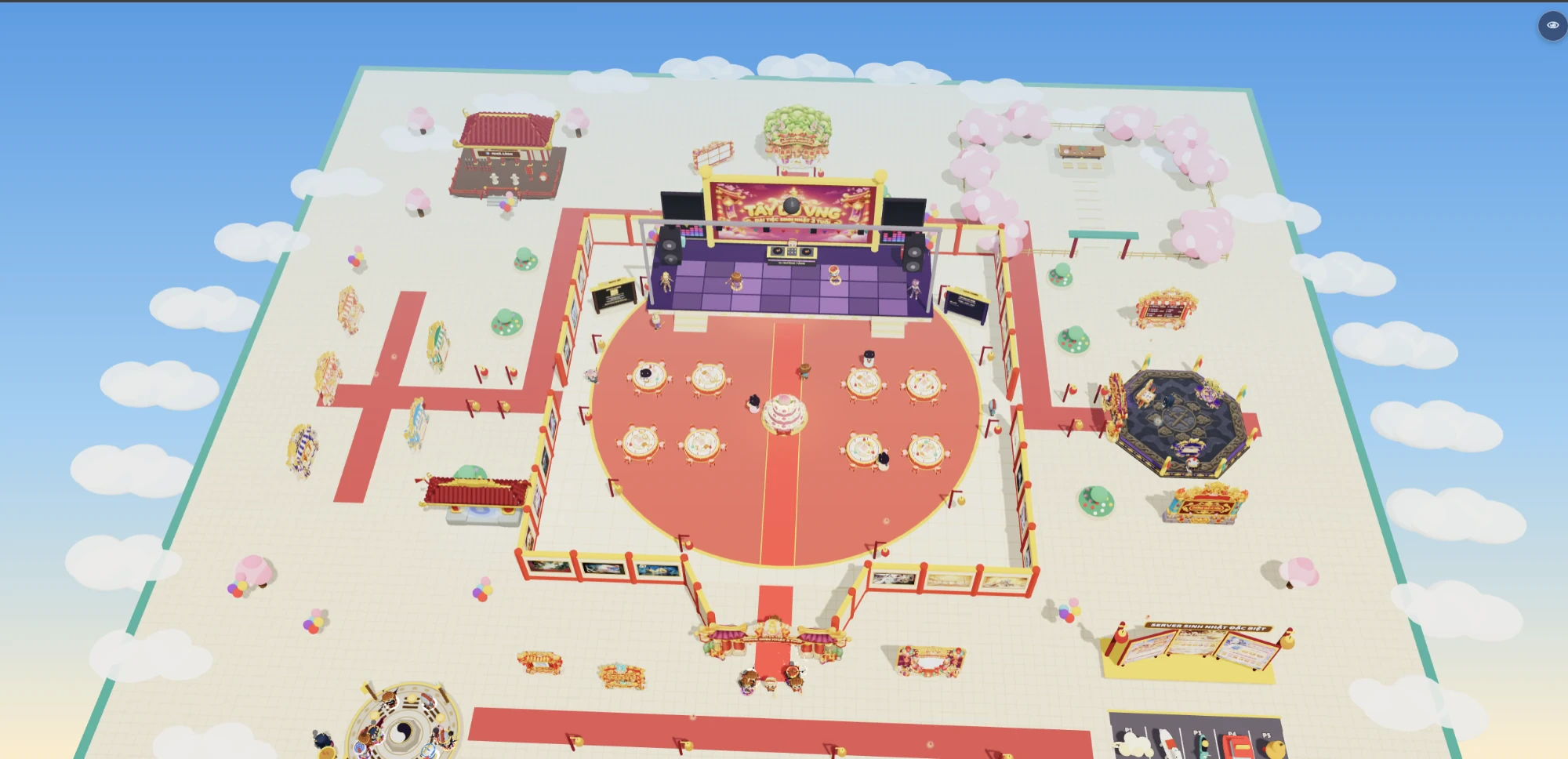
Objectives
For the third anniversary of Tay Du VNG, the team launched a minigame website with two main objectives:
- Reward distribution. Add a channel where players take part in minigames and earn reward codes. Codes are issued the moment a milestone is reached, with no manual collection and distribution step; players then enter the code on the redemption page.
- Community engagement. Provide a social and competitive space outside the main game.
It also served as a test of whether a minigame can add activity for long-tenured players.
Headline results
Over the first nine days the website recorded 1,937 accounts, 26,336 minigame plays and 5,168 reward codes issued. Against in-game data, 869 accounts redeemed a code, equal to 6.9% of all active players between 17 and 25 Nov.
Participants gained an estimated 0.61 hours of play time per player per day compared with a matched control group. The largest improvement came from players with more than two years of tenure, at 0.73 hours per day.
On community engagement, head-to-head activity drew 601 participants and held a steady match count. Chat, group photos and birthday messages were concentrated in the opening days.
Assessment. The minigame shows early effectiveness at adding activity for existing players. Reach remains low, and the social features are not sustaining regular interaction.
03
Website operating metrics
Scale
Daily website visitors, split into first-time and returning. Unit: people. Source: website activity log.
The website averaged 588 active users per day. The opening day reached 824, after which traffic held between roughly 500 and 800 per day before easing to just over 400. Of the 1,937 accounts in total, 1,179 tried at least one minigame.
Return rate
Return rate by the day a player first joined. Unit: percent. D+7 is not shown for cohorts from 20 Nov onwards, as there is not yet enough observation time.
The opening-day cohort returned at 50.8% on D+1 and 30.7% on D+7. Across all cohorts the return rate was 39.6% at D+1 and 27.2% at D+7. From 20 Nov, D+1 for newly joining cohorts fell to roughly 23–28%, indicating the content is less compelling for later arrivals.
Assessment. The website holds a core group of regular returners, but new content or staged activities are needed to lift the return rate of later joiners.
How to read these figures. Daily active users and return rate here are website metrics, measured on website visitors. The main game's retention metric is measured on newly registered in-game users. The two populations differ, so these figures are for reference only and should not be used to conclude that one retains better than the other.
178 accounts from the invite-a-friend test were excluded from the daily-active and return-rate figures, since that group did not find the event on their own.
04
Reward distribution
Conversion
Conversion funnel from website account to in-game code redemption. Unit: accounts. All figures cut off at 25 Nov.
Of 1,937 registered accounts, 1,179 played a minigame, 977 received at least one code and 869 were confirmed to have redeemed in game. Conversion from website account to in-game redemption reached 44.9%. The largest drop-off sits between registering and playing, where 39.1% of accounts never started a game.
Redemption rate
| Basis | Issued | Redeemed | Rate |
|---|---|---|---|
| By person — recipients and redeemers, both to 25 Nov | 977 | 869 | 88.9% |
| By code — excluding codes issued in the final two days issued ≤23 Nov, redeemed ≤25 Nov | 4,736 | 4,030 | 85.1% |
| By code — all codes, same cut-off date | 5,168 | 4,030 | 78.0% |
By person, 88.9% of code recipients redeemed at least one code in game. This is the most stable measure because both sides count accounts and share the same cut-off date.
By code, the rate depends on whether recently issued codes are excluded: 85.1% without the final two days, 78.0% across all codes. At the 20 Nov mark the same ratio stood at 94.2%.
The redemption rate is declining. In the opening phase players redeemed almost immediately after receiving a code. The later the event runs, the larger the pool of codes received but not yet redeemed — by 25 Nov roughly 1,100 issued codes had no matching redemption in game. Players appear to be stockpiling codes rather than entering them straight away. Worth tracking through to the end of the event.
Effect of the code cap
Codes issued per day. Unit: codes. 21 Nov marks the point where the most active players began hitting the cap of 8 codes per account.
Daily code issuance dropped sharply from 21 Nov. One of the main causes is that 343 players had reached the cap of 8 codes per account. Looking at the 142 players who reached the cap earliest, 86.6% returned to the website the following day and average session time held at roughly 67–70 minutes per day.
Assessment. The code cap is now limiting distribution volume, while a share of players still want to keep playing. Adding reward milestones or new activities for the closing phase is worth considering.
05
Impact on in-game play time
Comparison
Average in-game play time before and during the event. Unit: hours per player per day. Sample of 670 players matched by server, level band and spending tier.
Average play time among code redeemers rose from 1.49 to 2.33 hours per day, a gain of 0.84 hours. Over the same period the control group moved from 1.01 to 1.24 hours, a gain of 0.23 hours. After removing the general movement seen in the control group, the additional play time is estimated at about 0.61 hours per player per day.
Re-running the same comparison on a period before the event produced a difference of close to zero between the two groups, which supports the conclusion that the minigame contributed to the increase.
Participation level and play time
In-game play time by number of codes redeemed. Unit: hours per player per day. Sample of 780 players who redeemed codes.
Players redeeming 1–2 codes gained 0.5 hours per day on average, those redeeming 3–5 codes gained 0.6 hours and those redeeming 6–8 codes gained 0.9 hours. The gain rises with participation, though that group also started from a higher baseline, visible in the before-event bars.
By player tenure
Gain in play time after subtracting the control group, by tenure. Unit: hours per player per day. Sample of 630 matched players.
Players with more than two years of tenure form the largest group in the sample at 212 people and gained 0.73 hours per day. The 1–6 month group gained the least at 0.34 hours, and also had the highest pre-event baseline at 2.01 hours per day.
Assessment. The minigame is positively associated with in-game activity, particularly among frequent participants and long-tenured players. Further rollouts are needed to establish the long-term contribution.
On the total-hours figure. The 0.61 hours per player per day is measured directly on the matched sample of 670 players. The figure of roughly 4,800 additional hours is extrapolated to all 869 redeemers over nine days; it is not a directly measured total.
06
Impact on player retention
Gap in still-active rate between redeemers and the matched control, separating the gap that already existed before the event. Unit: percentage points. Sample of 344 accounts that first redeemed on 17 Nov.
Among the 344 accounts that first redeemed on 17 Nov, 95.3% were still active after seven days, against 83.8% for the control group. However, checking the pre-event period shows the participating group was already more engaged. After adjusting for that pre-existing gap, the D+7 improvement is estimated at around 4 percentage points.
Assessment. The early signal on retention is positive, but the size of the effect needs further confirmation. At this stage the play-time gain rests on firmer analytical ground.
07
Participation behaviour




Breadth of play
Distribution of how many different minigames each player tried. Unit: people. Sample of 1,179 players with at least one play.
Of 1,179 players, 360 tried only one game, 463 tried all six and 356 tried between two and five. The split shows a clear divide between players sampling the event and players engaging with it fully.
Cultivation progression
Players reaching each cultivation stage. Unit: people. Data to 25 Nov.
1,050 players started at the first cultivation stage and 764 reached the second. Numbers fall steadily through each stage, and after nine days only 7 players had reached the ninth and highest stage. The system therefore still has content left for the closing phase of the event.
Code milestone completion
Players completing each code milestone. Unit: people. Data to 25 Nov.
Completion is uneven across milestones. Code 7 was claimed by 828 players, while Code 4 and Code 5 reached only 454 and 465. The conditions on the lowest-completion milestones should be reviewed to balance difficulty against reward access.
Assessment. Engaged players want to try multiple activities. Future rollouts should add guidance and quests that link the minigames together to raise multi-game participation.
08
Community engagement
Player-to-player interaction
Average number of days visiting the website by interaction type. Unit: days. Covers all website visitors between 17 and 25 Nov.
Players who both chatted and played head-to-head visited on 6.88 days on average, against 1.55 days for those with no interaction. The interacting group also recorded more minigame plays and more codes earned. Social activity is clearly associated with participation level, though this is not enough to establish that interaction directly causes the higher return rate.
By activity type
Daily activity level, indexed to 100 on each activity's first day. Unit: percent of day one. Indexed because the four activities are counted in different units.
Head-to-head matches drew 601 participants and held a relatively steady match count throughout the period. Birthday messages, group photos and chat all fell sharply after the first days. Most players who took part in head-to-head matches faced only a small number of opponents, with 262 of 601 facing just one.
Limits of the shared space
The website averaged 21.7 concurrent users, peaking at 105. The 19:00–20:00 window was the busiest with an average of 49.6 concurrent users. Player density is not yet high enough to sustain regular interaction in the 3D space.
Assessment. Head-to-head play is the most durable social activity. At the current scale, future rollouts should prioritise activities for two to four players or automatic matchmaking, rather than features that need many players online at once.
09
Reach and new-player acquisition
Reach
Share of daily active in-game players who redeemed an event code. Unit: percent. Source: in-game data 17–25 Nov.
Between 17 and 25 Nov the main game recorded 12,654 active accounts, of which 869 redeemed an event code, equal to 6.9%. The daily share fell from a peak of 7.4% to 0.9% by 25 Nov, coinciding with many accounts reaching the code cap.
Acquisition channel
The minigame was promoted only in the game's community groups. There is no advertising campaign and no entry point inside the game. Players learn about the website from group posts and share it among themselves, so all traffic is organic.
The 6.9% reach should be read in that light: it was achieved entirely through community channels, with no paid media and no in-game entry point. The room to grow lies in adding official access routes, starting with an in-game campaign through the IAM system.
Composition of participants
Of the 869 accounts that redeemed a code, 835 were existing players, or 96.1%. Only 34 accounts started playing the game during the event period.
Assessment. The event primarily reached and served existing players, in line with its original objective.
10
Conclusion and next actions
What worked
The minigame met its objectives of distributing rewards, adding activity and increasing play time among participants. Head-to-head minigames and the code-milestone system both proved better at bringing players back than one-off social features.
What needs improvement
- Reach is limited because the website operates separately from the main game.
- Several community activities lose engagement quickly after the first day.
- The code cap leaves the most active players without a goal to pursue.
- Website and in-game data are not fully synchronised, which limits performance measurement.
Next actions
| Horizon | Action |
|---|---|
| Short term during the event | Review the conditions on low-completion code milestones, add activities for players who have reached the cap, and keep head-to-head formats running |
| Medium term next event | Complete the identity SDK, reward APIs and WebView to bring the minigame inside the main game |
| Long term | Develop the minigame into a reusable system for LiveOps events and add tracking to measure impact on retention, engagement and revenue |